
by Altgence

Message encryption / four modes

Encryption with a
visible trust boundary.

OpenPGP in the open-source core. S/MIME, HSM-backed keys, directory discovery and policy in Enterprise. Or move the private key into the browser and make the message end-to-end encrypted.

  • OSS coreServer-managed OpenPGP
  • EnterpriseS/MIME, HSM, policy
  • Client-sideBrowser-held E2EE
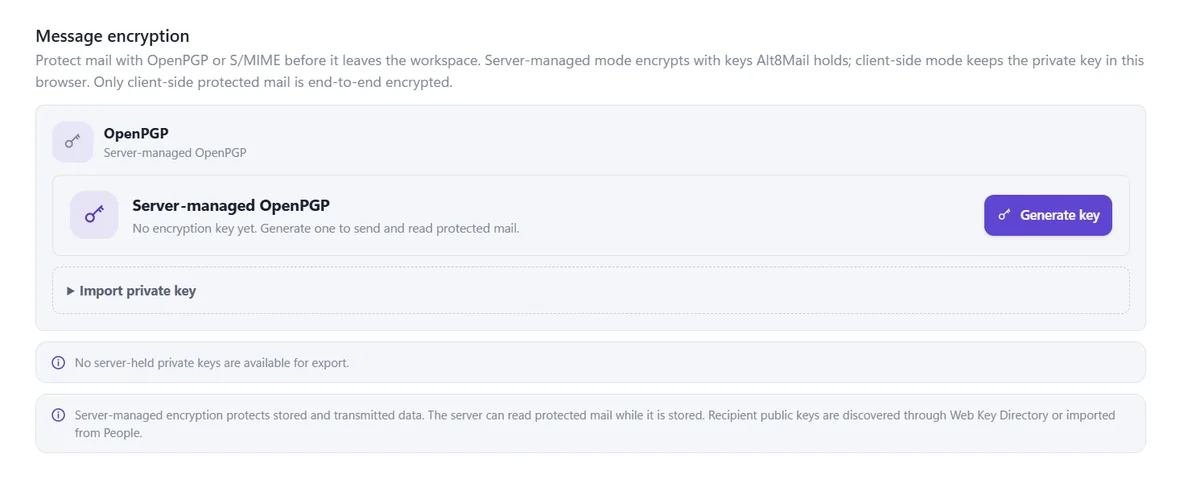
Alt8Mail message encryption settings for server-managed OpenPGP, including key generation and import.
Server-managed OpenPGP is available in the open-source core.

The boundary / plain language

Two questions decide the model.

Where does the private key live, and what must the server be able to do? Alt8Mail makes that choice explicit instead of calling every encrypted message end-to-end.

Server-managed

The server holds the key.

OpenPGP is in the open-source core; S/MIME, HSM-backed identities and enterprise policy extend it. Mail is protected in storage and transit, and the webmail reader can decrypt it.

The server can decrypt server-managed mail. This is protected mail, not end-to-end encryption.
Browser-held / client-side

The browser holds the key.

OpenPGP or S/MIME keys are passphrase-encrypted in the browser. Only ciphertext and outer headers go to POST /api/send; decrypted content stays in memory.

Only client-side protected mail is end-to-end encrypted. The server cannot read it.

Open-source core

OpenPGP without a licence gate.

  • Server-managed OpenPGP key generation and armoured private-key import.
  • Rotate and revoke keys; retired keys still decrypt old mail.
  • PGP/MIME sign, encrypt, sign-and-encrypt and decrypt.
  • WKD public-key lookup, contact keys, TOFU change tracking and encrypt-to-self.
  • Envelope encryption and webmail decryption with signature badges.

Paid Enterprise

Governance around the key.

  • Server-managed S/MIME with PKCS#12/PFX or PEM import and chain validation.
  • Directory discovery, LDAP certificate lookup and shared-mailbox key management.
  • HSM/PKCS#11-backed signing and decryption; the private key never leaves the token.
  • Policy enforcement, key escrow/recovery, audit/retention and gateway integration.
  • Tenant control over browser import, delegated decryption and migration state.

Edition entitlements are confirmed during evaluation. Server-managed modes are not end-to-end encryption. Client-side modes are enabled by tenant policy and have deliberate feature trade-offs.

The modes / choose deliberately

Four paths. One explicit choice.

Each mode supports OpenPGP, S/MIME or both according to tenant policy. The UI tells the user which boundary is in force, and the policy that enables a client-side mode also accepts its operational limits.

01 / OSS core

Server-managed OpenPGP

  • Generate a server-managed key, import an armoured private key, rotate and revoke.
  • Active and retired keys stay available for decrypting old mail.
  • PGP/MIME sign, encrypt, sign-and-encrypt and decrypt; encrypt-to-self for the Sent copy.
  • Recipient lookup through contacts and WKD, with TOFU/key-change tracking.
  • Protected attachments are encrypted in outbound MIME.

Current limit: server-managed OpenPGP attachment parts are not yet surfaced in the webmail reader; they remain available through the original IMAP/DAV client.

02 / Enterprise

Server-managed S/MIME

  • Import PKCS#12/PFX or PEM certificate, private key and chain.
  • Validate validity, email SAN, emailProtection EKU, key usage, RSA encryption and CA roots.
  • CMS SignedData and EnvelopedData, sign-then-encrypt and AES-256-CBC.
  • Detached signature verification, signer identity and contact trust mapping.
  • Active/retired certificate rotation, optional PKCS#11 signing and OCSP/CRL revocation.

LDAP certificate discovery is optional and configured by the operator.

03 / Client-side E2EE

Browser-held OpenPGP

  • Generate or import a browser key, passphrase-encrypted in IndexedDB.
  • Publish only the public key to the tenant directory.
  • Encrypt, decrypt and verify signatures in the browser; encrypted inline attachments and reader preview.
  • Browser-local encrypted drafts and account-level encrypted key backup, restore and delete.
  • Alias-aware publication for every owned address covered by a key UID.

04 / Client-side E2EE

Browser-held S/MIME

  • Import a password-protected PKCS#12 bundle; re-encrypt it with the user passphrase in IndexedDB.
  • Publish only the certificate chain.
  • CMS sign, encrypt, decrypt and verify signatures in the browser.
  • Read both multipart/signed inner content and attached CMS SignedData.
  • Per-alias certificate publication when the SAN covers the alias; recovery through an exported PKCS#12 bundle.
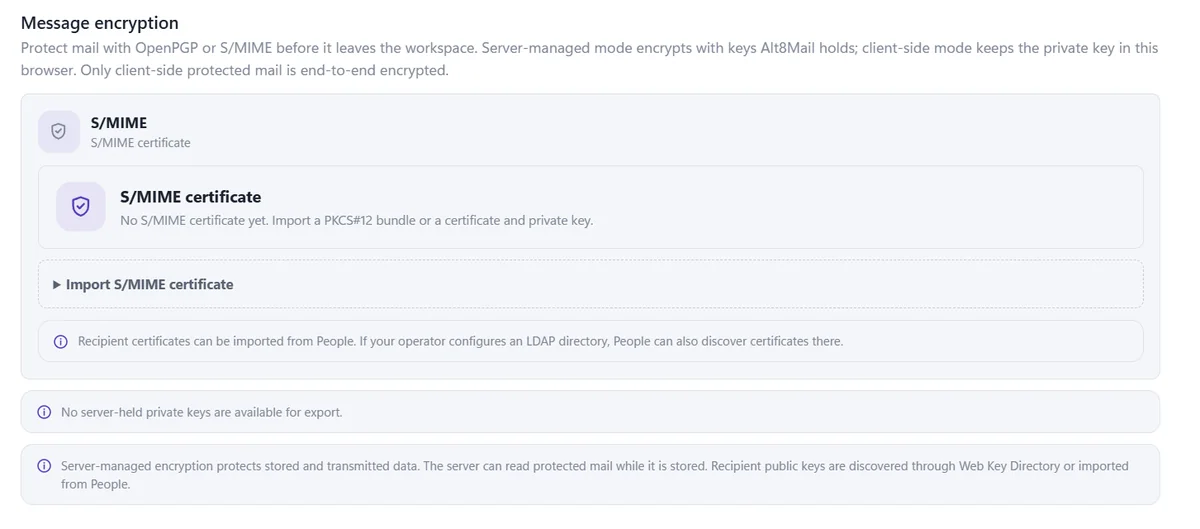
Alt8Mail S/MIME certificate settings with import controls and a note that server-managed encryption lets the server read stored protected mail.
Server-managed S/MIME is an Enterprise capability. The interface states the boundary: the server can read stored protected mail.

The trade-off / not a checkbox

Client-side encryption changes what the server can do.

A browser-held mode rejects plaintext sends. That protects the message, and it deliberately removes server-side features that need plaintext access.

What stays true

  • Only ciphertext and outer headers reach POST /api/send.
  • Raw ciphertext downloads carry Cache-Control: no-store.
  • Decrypted content stays in memory; locking clears messages and closes client-side composers.
  • Private keys remain passphrase-encrypted in the browser.

What the client-side mode disables

  • Server-side body search and AI assistance.
  • DLP inspection and server-held drafts.
  • Delegated decryption and plaintext API sends.
  • Automation auto-replies and phishing-campaign delivery.

Policy is the product. A tenant that turns on client-side E2EE should expect the matching loss of server-side search, DLP, delegation and automation. Alt8Mail makes that trade-off visible before an administrator enables it.

Discovery, trust and revocation

Keys are useful only when you can verify them.

Alt8Mail combines directory lookup, explicit trust and revocation checks instead of treating a public key as a permanent fact.

Discovery and trust

  • Advanced WKD for browser OpenPGP keys at /.well-known/openpgpkey/hu/{hash}?l={localpart}.
  • Direct-host WKD for openpgpkey.<domain>, with its own DNS record and certificate.
  • Tenant key/certificate directory and manual contact import, discovery, verification and deletion.
  • Browser-side TOFU fingerprint pinning for OpenPGP and S/MIME, explicit re-trust after a change, and alias-specific active rows.
  • Server-side contact key change and revocation warnings.

Revocation without guesswork

  • OCSP first, CRL fallback; off, soft and require modes.
  • Configurable timeout, cache lifetime and private-target permission.
  • Redirect rejection, target allow-listing and an 8 MiB response cap.
  • Revoked certificates are always invalid. Unknown status is a warning only in soft mode.

HSM / PKCS#11

  • Server-managed S/MIME can use token-backed identities configured through Alt8Mail.
  • The private key never leaves the token; the integration implements crypto.Signer and crypto.Decrypter.
  • CMS signing uses CKM_RSA_PKCS over DigestInfo; decryption unwraps the CMS content key.
  • Startup sign/verify self-test, certificate-only identity import, and builds with -tags pkcs11 and CGO_ENABLED=1.

Browser smart-card access still needs a native PCSC/PKCS#11 helper; it is not available without one.

The fine print / what we do not claim

A clear boundary is stronger than a broad claim.

  • Server-managed is not E2EE. The server can decrypt protected mail while it is stored.
  • Server-managed OpenPGP attachments are encrypted in outbound MIME but not yet surfaced in the webmail reader; use the original IMAP/DAV client for those parts.
  • Browser smart-card access requires a native PCSC/PKCS#11 helper that is not built into the webmail client.
  • Client-side mode rejects plaintext sends and disables server-side body search, AI, DLP inspection, server drafts, delegated decryption, plaintext API sends, automation auto-replies and phishing-campaign delivery.
  • Edition entitlements and tenant policy determine which modes are available. Confirm the current entitlement during evaluation.

Next step

Choose the boundary your policy requires.

Tell us whether you need server-managed OpenPGP, governed S/MIME, browser-held E2EE, or a staged migration between them.